A couple of weeks ago I brought my Gametrekking project to completion with the release of a downloadable collection of all the travel-inspired sketches I’ve created to date. I thought I’d go ahead and copy my retrospective blog post over here.
What about my writing? Will I start reviewing games again, now that the Gametrekking project is over? I’m thinking about it. Meanwhile, here’s my retrospective:
—
Today I am releasing the Gametrekking Omnibus, a downloadable collection of all of my Gametrekking creations to date. It is my tenth release of the Gametrekking project, and it will also be my final "official" release.
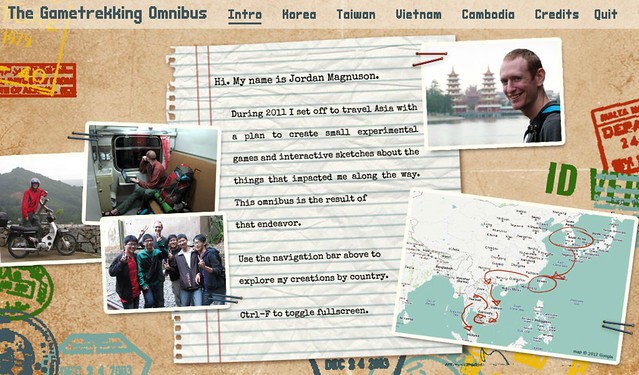
The omnibus includes an interface that lets you browse through all of my creations by country, some built-in slideshows to provide context, links to my written reflections, and new fullscreen versions of all my games and notgames.
To download the Gametrekking Omnibus For Windows:
- Download and run the native exe installer. Note that you need to be connected to the internet during installation, and it may take a while if you do not already have Adobe Air installed.
To download the Gametrekking Omnibus For Mac OS:
- Download and install Adobe Air from http://get.adobe.com/air.
- Download and run the Gametrekking Omnibus air file.

This is going to be the final official release of the Gametrekking project, because it’s been two years since the project launched, I’ve clearly finished "the journey proper," and a downloadable collection of the work I’ve managed to produce so far seems like as good a place to wrap things up as any. I say this is the "official" end of Gametrekking, because I see the project continuing on indefinitely in some sense… It seems certain that I will keep traveling into the future in some capacity or another, and that I will continue to experiment with interactive sketches and notgames about the things that impact me. But still, I think the Kickstarter project deserves some kind of closure, and that’s what I’ve tried to create with this downloadable collection.
When I launched this project two years ago on Kickstarter I didn’t know if I was going to be able to successfully fund it, but was soon amazed by the support and generosity of the family members, friends, internet acquaintances, and complete strangers who pledged their support, and made this thing a reality.
Once the project was funded, I still didn’t know if it was going to be a success or not—or even how to judge it as such. All I had was a backpack, a half-formed itinerary of shoestring travel through a few countries in Asia, and a vague plan to make interactive sketches about the things that impacted me along the way—to try and use experimental computer games as a kind of "travel writing," whatever that would mean.
The journey turned out to be incredibly challenging—but also incredibly rewarding. I struggled to fulfill my naïve promise of making computer games from the road while attempting to balance the day-to-day requirements of independent travel (where I seldom knew where I would be spending the night from one day to the next, much less whether I would have access to the internet), but the experiences I had along the way, and the people I met, more than made up for the difficulties. Hitching a ride with some fishermen on Taiwan’s east coast; seeing the Killing Fields of Cambodia with my own eyes; discussing the merits of Facebook with a college student in the Mekong Delta… these are experiences that I would not trade for anything.

Hitchhiking on Taiwan’s East Coast.
But still I am left with the question, as the project draws to a close, of whether Gametrekking was a "success." On a personal level I can look back and see that my life has been irreversibly enriched by my travels and my coding; I tried to capture some of the ways in my travel writing. Which is fine and well, but I don’t want to conflate the project with the journey (however hard it is to separate the two in my mind): the journey was personal, but the project was funded, and of a corporate nature. The question is complicated by the fact that I never defined what "success" for Gametrekking would look like, as such. Partly this was, perhaps, an oversight, but partly it was the nature of the beast: the entire venture has always existed as a kind of "leap of faith," both for myself, and for my backers—a project of possibility, of seeing what would come of a crazy, uncertain idea.
Does one consider success quantitatively, or qualitatively? When I think in terms of quantity, I cannot help but be disappointed: I wish I had a hundred creations to show for my efforts, rather than ten small offerings. I think of all the failed prototypes, and consider mounting them for display, to create a bigger catalog: I wanted to make something for every country that I traveled through, after all, and if I published my failed experiments, I could get there, and then some. But I cannot do it, because I cannot see this thing as an attempt to make a flash game for every country in Asia, like some kind of bizarre interactive Lonely Planet collection. Rather, the games have always been about expressing something personal, for me, even though they are merely sketches and doodles. And so I struggle more than I should with each one, and throw too many prototypes away, and come back too often empty-handed.

An early prototype for "The Great Moped Balancing Act", one of many creations I never published.
Still, I can try and point to other numbers in an attempt at vindication: I can say that my Gametrekking creations, while few, have together been played nearly half a million times, that they have appeared on the front page of Newgrounds, been featured in Wired and EGMi, been used for psychology research…
But such claims ring hollow. If the goal of Gametrekking were big numbers, then making sketchy notgames about the kindness of strangers, or visiting your grandmother’s tomb, becomes a laughable waste of time.
Slightly more to the point, perhaps, is the "why" behind the figures: the fact that Newgrounds creator Tom Fulp found two of my sketches interesting enough to feature on his front page despite the fact that they are light-years away from the fare his audience is typically expecting, to expose them to something different. Or the fact that the folks at Extra Credits considered my small notgame "Loneliness" worthy of spearheading two episodes of their show, as a glimpse of something interactive creations should strive for. Or the fact that Patrick Klepek wrote up "The Killer" for Giant Bomb, because he found it a breath of fresh air in a world of "power fantasy" video games. This kind of qualitative assessment is a measure of success that I am vaguely interested in.
But we’re largely still in the land of vainglory. I enjoy a little spotlight as much as the next person, but I hope it’s not why I do what I do, and as such, I’m not willing to accept it as a measure of success.
What’s left?
Just the regular people who play my games, and the notes I get from them. A lot of these are negative. A lot of them tell me to go do something hateful to myself, because I’ve wasted somebody’s time. But every once in a while I get a message like this one regarding "Freedom Bridge":
I just registered on this forum to tell you that this was one of the most intense interactive experiences I’ve ever had. I went on and watched some short documentaries about Korea afterwards in order to process the tension it had left me with.
Or this one in response to "The Killer":
I have seldom experienced such raw emotion from a video game. I have traveled to a few of the places featured in your games and learnt a small proportion of their history in the process. however, after playing each game I had to research more and more and more. Thank you for making such simplistic and emotionally provoking games!
Or this one, about "Grandmother":
Unforgettable. Simple and stunning. Kinda reminds you not to forget about the one’s you’ve lost.
Or this one, posted on the Newgrounds page for "The Heart Attack":
Something I’d like to say… Jordan, your ‘notgames’ have done something. They hack and slash at the curtains we put up to shield ourselves from the ugly truth. That in reality, evil is decided by the individual. Among other messages. This, and your other games have a simple brutality, depressing and dark. But it’s also deeply informative and touching. They’ve given true insight on the human range of emotions, I’d say. I know that these short notgames you create bring out the best in my character. Make me sad, make me happy and many times, severely upset. I know I’ve learned from you, as many others could say they have. So please, keep on trekking. I want to learn more.
Or this one, about "Loneliness":
Thank you for that gaming experience… I had to get an account JUST so I can thank you for it… somewhere when the dots were slowing down, I said to myself, "I don’t want to go near them… I don’t want them to leave too" and I honestly Cried. I have never had to set the metaphysical controller down, and take in that level of emotion. I then realized that the game was called "Loneliness", and I started to reach back into my own memories of not being able to fit in at school, and then I realized that I needed to try ONE least time. The same thing happened in Life, and I am currently married to the only Girl that wouldn’t reject me, in the end of all that loneliness. I, again, thank you for that wonderful experience. Thank you… SO MUCH for this moment of self-reflection.
Or this one on, "Status Quo’s" Newgrounds page:
Taiwan… That is my home…!! Thank you for making such a project about our precious little island. I really appreciate it.^^
Or this one, in response to "The Kindness of Strangers":
Wonderful story, it’s almost surreal. Being born and raised in the more impoverish parts of the states, the only thing I’ve ever known from people is deception, greed, and hatred.
I don’t post these here for a whoop-dee-doo congratulations, or a pat on the back. I post them to share with you honestly why I consider the Gametrekking project to have been a success. I post them for those of you who backed my project, and wanted it to come to something.
Ultimately, regardless of how many games I make, I have to ask myself why I’m making them; if there’s not a good reason, I don’t care if I’ve made ten or a hundred. I find the numbers, whether of games, or of plays, to be abstract and meaningless in and of themselves. Likewise, the front-page mentions and five minutes of fame quickly fade. It’s comments like the ones above that keep me going. At the end of the day I don’t care about the ratio of negative comments to positive ones: only that the positive ones exist. In my mind, if my Gametrekking creations got one person to look up the conflict between North and South Korea, got one person to remember their grandmother, got one person to believe that Taiwan’s a real place, or got one person to reflect on the nature of isolation, then the project was a success. So I have to consider it a success. I can’t force my definition on anyone else, but I do hope that my backers will agree with me.
It’s been a wonderful journey, and I thank you all from the bottom of my heart.
-Jordan




 . I know that some people like to read but don’t leave comments, so here’s your chance to let me know who you are, so we can start to develop a little sense of community. No more reviews until you sign. Cheers.